Artificial intelligence in your own home
Same memory. Solid performance. Half the price.
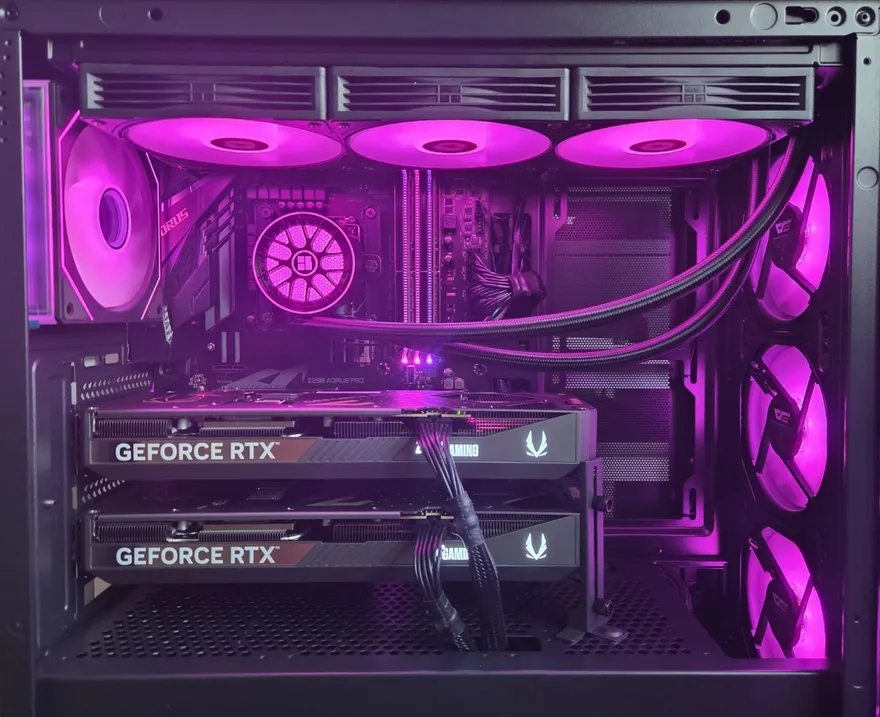
You do not need a €4,650 ($5,350) flagship graphics card to run a serious language model at home. Two mid-range cards give you exactly the same amount of memory — and memory is what decides how large a model you can run at all. We built such a machine, measured it, and here are the results.
RTX 5090 — one flagship card
- Memory
- 32 GB
- Price
- €4,400–4,650 ($5,100–5,350)
RTX 5070 Ti — two cards
- Memory
- 16 GB + 16 GB
- Price
- 2 × €1,050 = €2,100 (2 × $1,200 = $2,400)
| Variant | Memory | Price |
|---|---|---|
| RTX 5090 — one flagship card | 32 GB | €4,400–4,650 ($5,100–5,350) |
| RTX 5070 Ti — two cards | 16 GB + 16 GB | 2 × €1,050 = €2,100 (2 × $1,200 = $2,400) |
The memory of both cards adds up: the model splits in half, one half computes on the first card, the other on the second. From the outside it looks like a single computer with 32 GB of graphics memory — at 47% of the flagship's price.
European retail prices, August 2026. NVIDIA has already raised prices twice this year — by 10–15% in January across the whole RTX 50 line, and in May on the RTX 5090 alone — and the announced third increase is expected to reach 20–30%. The reason is GDDR7 memory getting more expensive, with the shortage forecast to last until at least 2028. The increase hits both variants, but not equally: the same 30% means about €630 ($720) on the pair of cards and close to €1,390 ($1,600) on the flagship.
- of graphics memory for models
- 32 GB
- of graphics memory for models
- tokens per second — it writes faster than you read
- ~200
- tokens per second — it writes faster than you read
- tokens of context, meaning several hundred pages at once
- 262K
- tokens of context, meaning several hundred pages at once
- power draw while the machine waits
- 120 W
- power draw while the machine waits
Use cases
Four things we built it for
Conversation
Your language, without the awkward phrasing
An assistant that writes and translates naturally in your language — the models are multilingual, and we verified the quality on our native Polish, one of the harder languages to get right. It answers faster than you can read the previous sentence, and the whole conversation stays on a disk at home.
Image and video
It sees what you show it
A photo, a scanned document, a clip up to a minute long — the model describes, summarizes and extracts data. Without sending private files to someone else's server.
Programming
Writes code and checks it itself
It gets a task description and works on its own: creates files, runs tests, fixes bugs. In our test it delivered complete projects of 1,500–3,000 lines.
Search
Reaches for fresh information
Its own search engine on the same machine lets the model check today's facts — no account, and no trail of queries left with a middleman.
Proof
Forty projects written without our help
Instead of relying on claims, we gave the machine ten hard programming tasks and four different model configurations. Then we checked the results with our own tools — because a model can write in its documentation that the tests pass when they do not.
- autonomous runs
- 40
- autonomous runs
- for the full set of ten projects
- 3.8 h
- for the full set of ten projects
- acceptance criteria checked
- 284
- acceptance criteria checked
- met in the best configuration
- 71/71
- met in the best configuration
-
We ran the tests ourselves. The model's claim of green tests was never taken on faith — the runner executed them independently.
-
Performance requirements were verified by measurement. One of the models wrote a softer threshold into its documentation than the task required. It only came out at runtime.
-
The whole machine worked in isolation — on a separate account with no privileges, with access to the working directory only.
The electricity bill
About as much as a good refrigerator
We measured with a smart plug, counting the draw of the whole computer. Not just the cards, not in theory.
- waiting for a question
- 120 W
- waiting for a question
- typical work
- 256 W
- typical work
- heaviest configuration
- 352 W
- heaviest configuration
- momentary peak
- 580 W
- momentary peak
€1.32 ($1.52)
— that sum produced the forty projects from the test above — about €0.03 ($0.04) per task, at our Polish rate of €0.26 ($0.29) per kWh. Four tenths of that amount went into simply keeping the computer switched on.
Honestly
What this setup does not do
Speed.
The flagship card has memory twice as fast and will be quicker with the heaviest models. The advantage of two cards is capacity and price, not a speed record — though the writing pace still outruns the reader.
One at a time.
The machine holds one model in memory at any given moment. Switching to another takes a dozen or so seconds — in practice you pick a model for the task, the way you pick a program.
It will not replace everything.
The largest commercial models still win at the hardest tasks. For conversation, documents, images and everyday code, the difference stops mattering.
It needs looking after.
This is a server, not an out-of-the-box appliance: updates, backups, choosing models. That is why we describe the whole setup — including what did not work for us.
Lab
Everything described step by step
We have been documenting this machine since it was first switched on. Take a look if you want to build a similar one — or to check our numbers.
Why two cards make sense: how the model splits between them
Two graphics cards do not compute twice as fast — and that is not why you buy them. You buy them to add their memory together. Here is exactly what happens inside when a model spreads across two cards, and why this particular way of splitting wins on home hardware.
Read the article → 6 min read
How much context really fits in 32 GB
Context is the conversation's memory — everything the model has in front of it while forming an answer. After the model weights, it is the second-largest consumer of card memory, and it is usually what decides whether a configuration starts at all. We checked where the limit lies at 32 GB. The answer turned out to be surprising: most often it is not on the hardware side.
Read the article → 5 min read
The models we tested — and the ones that stayed
Thirty-two configured model versions passed through the machine. Ten working profiles built on four files stayed for good. Here is what decided promotion and what decided elimination — and why a more expensive file does not always mean a better one.
Read the article → 5 min read
How much electricity home AI uses in a year
We measured the draw with a smart plug — the whole computer, not just the cards, over a dozen-plus hours of continuous work. The conclusion is uncomfortable for intuition: it is not the computing that eats the most electricity, but simply keeping the machine switched on.
Read the article → 4 min read
A private search engine for your model, with no middleman accounts
A language model knows the world up to the day its training ended. To answer questions about today, it has to be able to search. We built our own search engine for this on the same machine — and along the way measured how much work it takes to get results in Polish, our native language.
Read the article → 4 min read